

DDR4 vs. DDR5: The Best Memory for PC Gaming
A few weeks agone we reviewed Intel's new Alder Lake architecture for the first time and with it we also got our commencement chance to play around with DDR5 memory. In our Core i9-12900K review, nosotros tested both DDR4 and DDR5 memory in a range of applications and games, to find that the faster, more expensive retention offered fiddling actress functioning for the most office, and this was particularly true for gamers.
A few titles did testify squeamish performance gains, but overall performance was much the aforementioned, leaving us to recommend prospective 12th-gen owners to ignore DDR5 for now and stick with tried-and-truthful DDR4. When nosotros published that review, which was prior to Alder Lake's release we had nonetheless to come across what DDR5 pricing and availability looked like, and were forced to comment based on feedback we had received from retailers and manufacturers.
They all told us DDR5 availability would exist poor, and pricing would be farthermost, and they were correct...

As of writing, most PC retailers have no DDR5 retentivity in stock. The nigh affordable 32GB kit we can find is the Kingston Fury Beats DDR5-5200 CL40 memory for $560, which is pretty ordinary retentiveness for that price. Over at Newegg, for instance, they have stock of ADATA DDR5-4800 16GB CL40 sticks at $330 per module. Meanwhile, the cheapest retentivity listed is a Corsair Vengeance DDR5-4800 CL40 32GB kit for $310. The DDR5-6000 CL36 retention that we used for testing in our 12900K review (and will exist using again today) costs $470 for a 32GB kit.
Based on pricing alone (and the fact that availability is about not-existent), DDR5 makes petty sense for virtually.

But DDR5 supply is expected to amend adjacent year, and so will pricing, so we wanted to take a more than in-depth expect at what DDR5 has to offer gamers when using an Alder Lake CPU, and this will help us make up one's mind at which point you should bother with the new memory technology.
In gild to do this, we've benchmarked 41 games at 1080p, 1440p and 4K using the Radeon RX 6900 XT. For testing DDR4 retentiveness we're using a G.Skill Trident Z Neo 3600 CL14 kit and for DDR5 memory the Trident Z5 RGB 6000 CL36 kit. The DDR4 memory was tested on the MSI Z690 Tomahawk Wi-Fi DDR4 and the DDR5 memory on the MSI Z690 Unify.

Nosotros've tested a massive corporeality of games, but we won't go over every championship individually. We take picked around a dozen games and so we'll check out a consummate breakdown that looks at margins in all titles tested.
Benchmarks
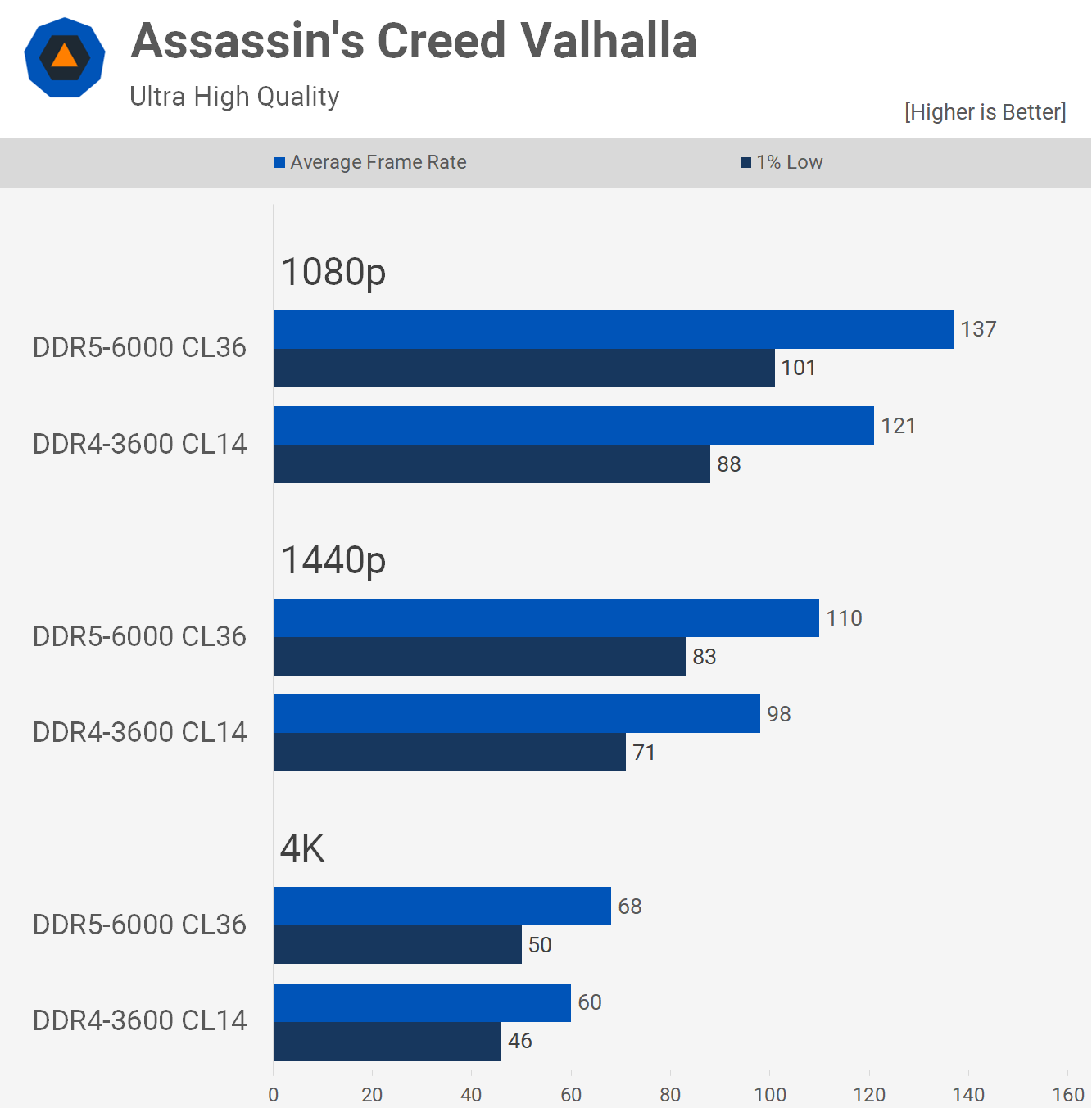
Starting with Assassinator's Creed Valhalla, we run into a 13% to 15% functioning improvement with newer DDR5 memory, taking the average frame rate from 121 fps at 1080p, to 137 fps. But more than impressive than that was the 17% performance boost seen at 1440p when looking at the 1% lows with a 12% boost to the average frame rate.
As expected, the margins close upwardly at 4K where the GPU becomes the key limiting factor, merely yet I was surprised to see a 9% boost to the 1% low and a 13% uplift for the average frame rate. So DDR5 is offering a articulate performance advantage in Assassin'southward Creed Valhalla.
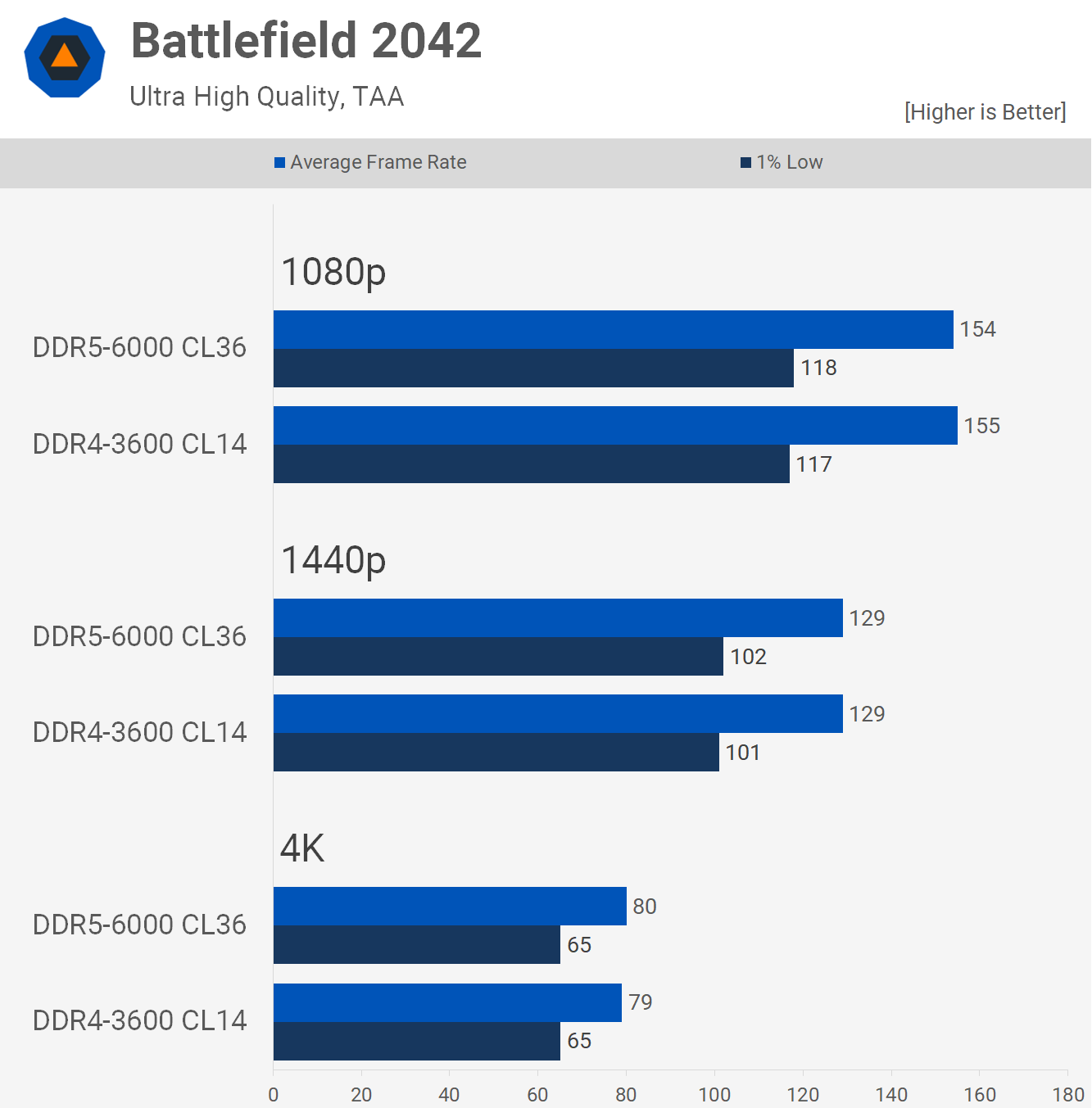
A game that doesn't benefit from the use of DDR5 retention is Battlefield 2042. Although this information is based on our easier to execute bot match, the 128 actor modes don't see whatsoever improvement with the higher bandwidth DDR5 memory either. So this one is a bust for the ultra expensive DDR5 retention.
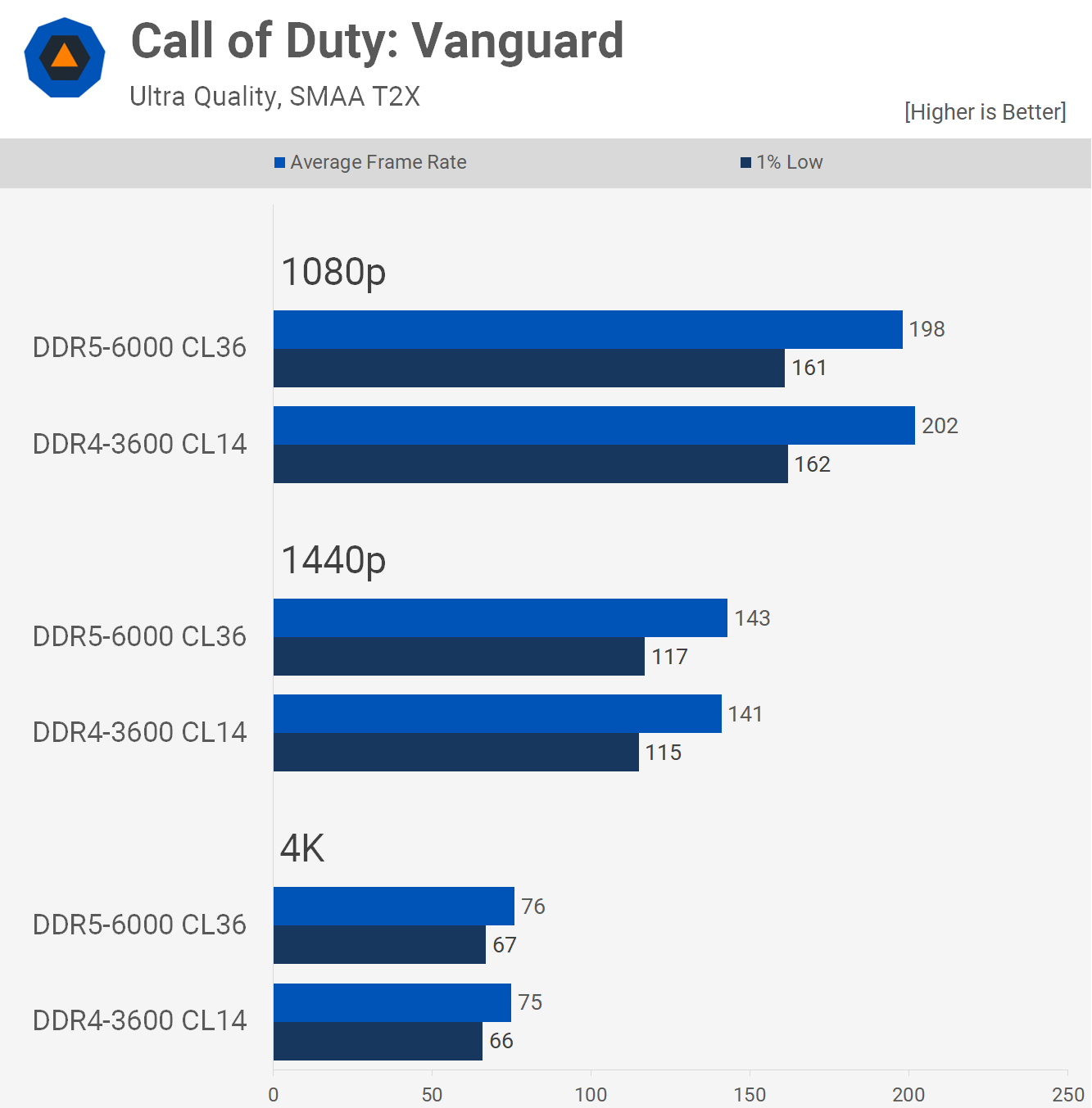
Call of Duty Vanguard is another game where we discover a negligible departure between the 2 memory types, fifty-fifty at 1080p. So information technology would seem this game isn't express by memory bandwidth.
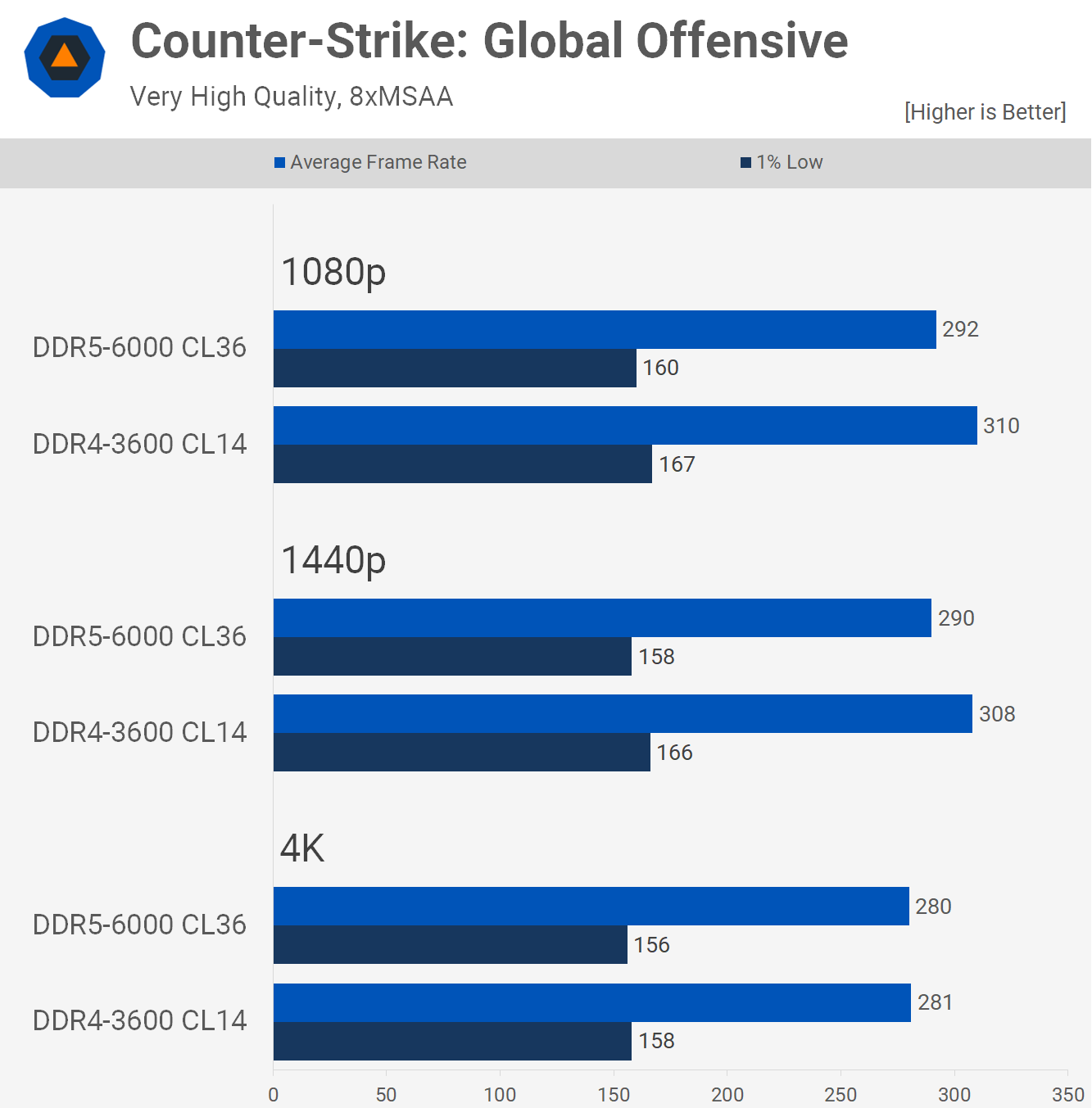
Counter Strike Global Offensive is a heavily CPU limited game, and here nosotros come across feeding the processor more bandwidth doesn't aid improve functioning at 1080p and 1440p, though nosotros're just talking about a minor single-digit deviation. But it appears as though lower latency memory is more than important for this title.
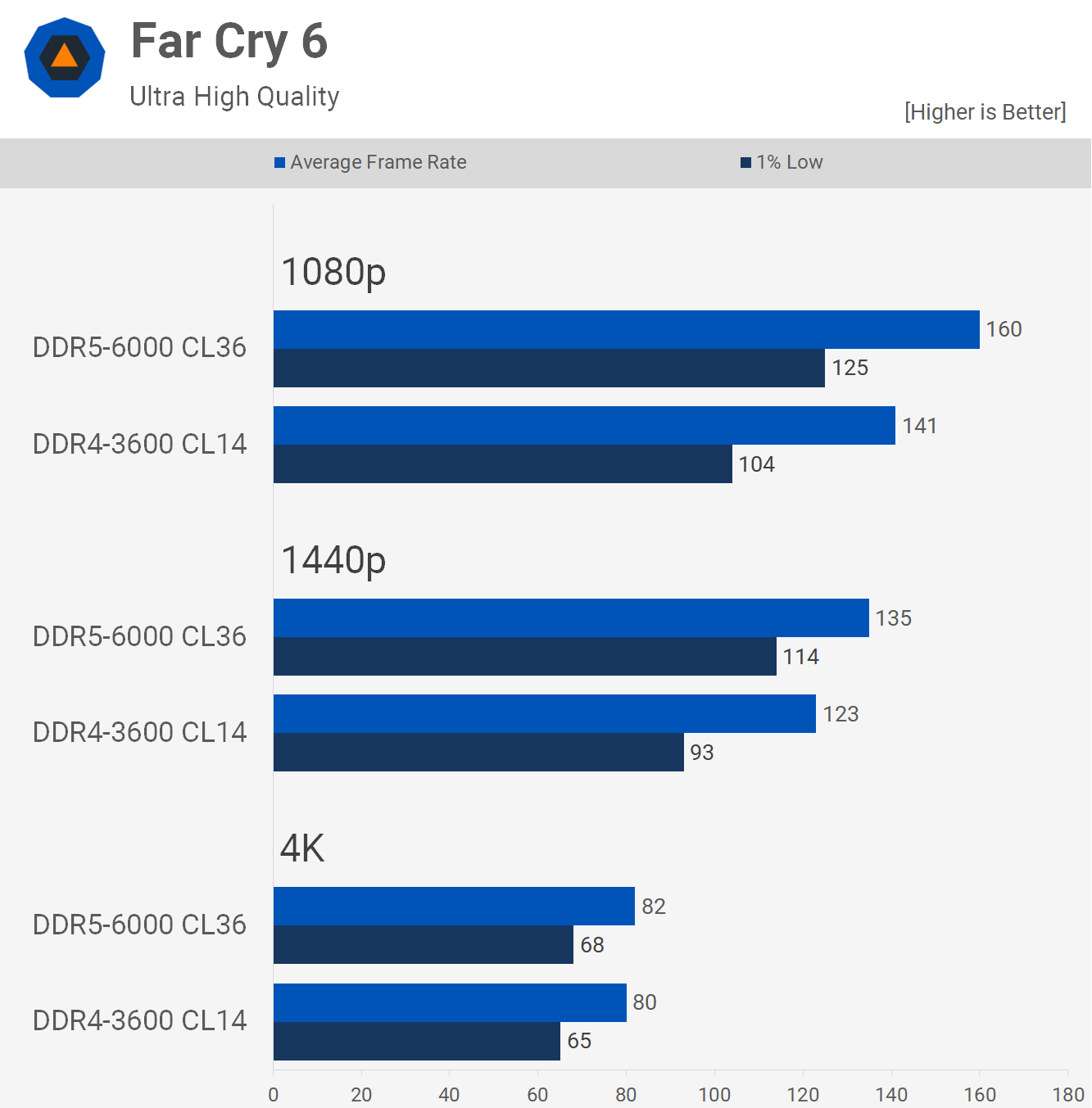
Interestingly, Far Weep vi benefits massively from college memory bandwidth and that's not because the VRAM buffer has been exceeded as nosotros're using a 16GB card. Rather, this game dips into the system memory quite heavily and as a outcome we're seeing up to 22% greater performance at 1440p when looking at the i% lows.
Even the boilerplate frame rate was boosted by 10% and 13% at 1080p. The margins are neutralized at the GPU-limited 4K resolution, simply notwithstanding some impressive gains at 1080p and 1440p in this title.
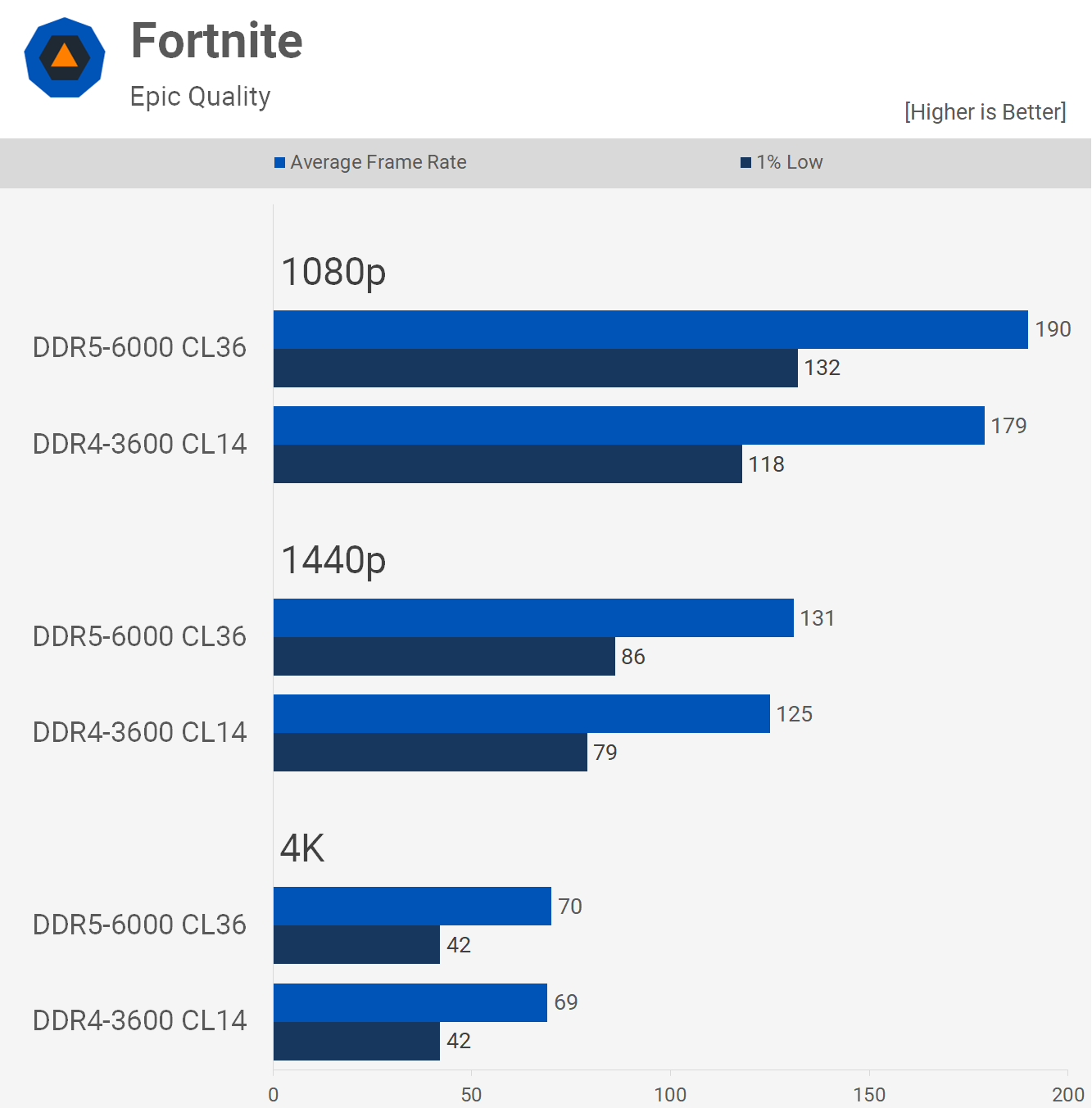
Fortnite also saw some benefit to using DDR5 retentiveness, though for the most part the margins were less impressive. Nosotros did see a 12% boost to the 1% lows at 1080p, with a 6% improvement for the average frame charge per unit and this was reduced to 5% at 1440p then nada at 4K.
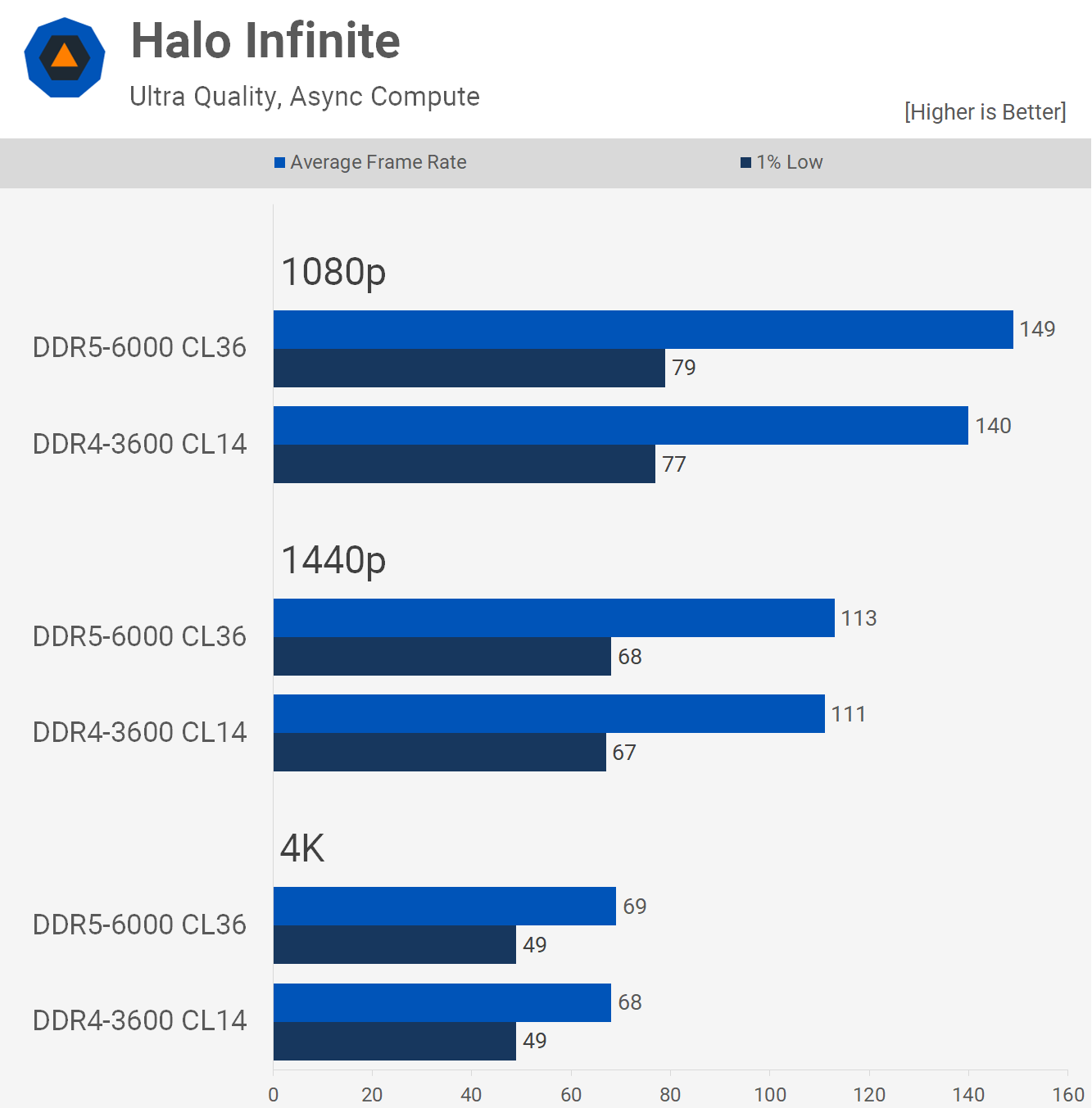
Next we have Halo Infinite and I played a bit further into this i and sadly I tin't go back to our enervating test included in our Halo Infinite GPU benchmark, and so it looks like I'll have to offset over and play for a few hours to get dorsum to that scene.
For now, nosotros accept this less enervating part of the game and here DDR5 offers very picayune over DDR4, though I doubtable this will likewise be truthful for more demanding scenes besides.
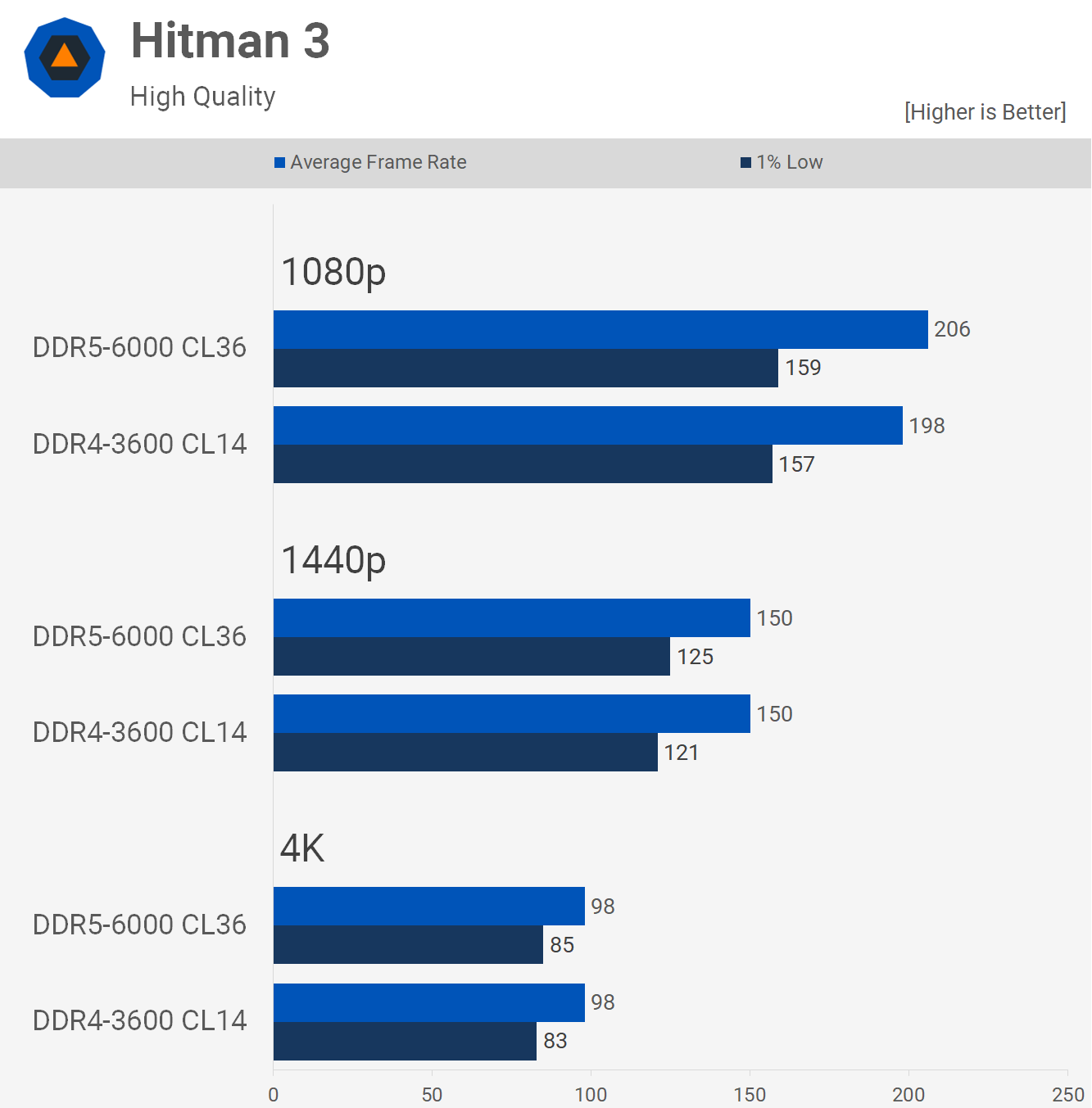
Performance in Hitman 3 gains next to nothing when using DDR5, we run across only a very small-scale increase at 1080p, with basically nil at 1440p and 4K.
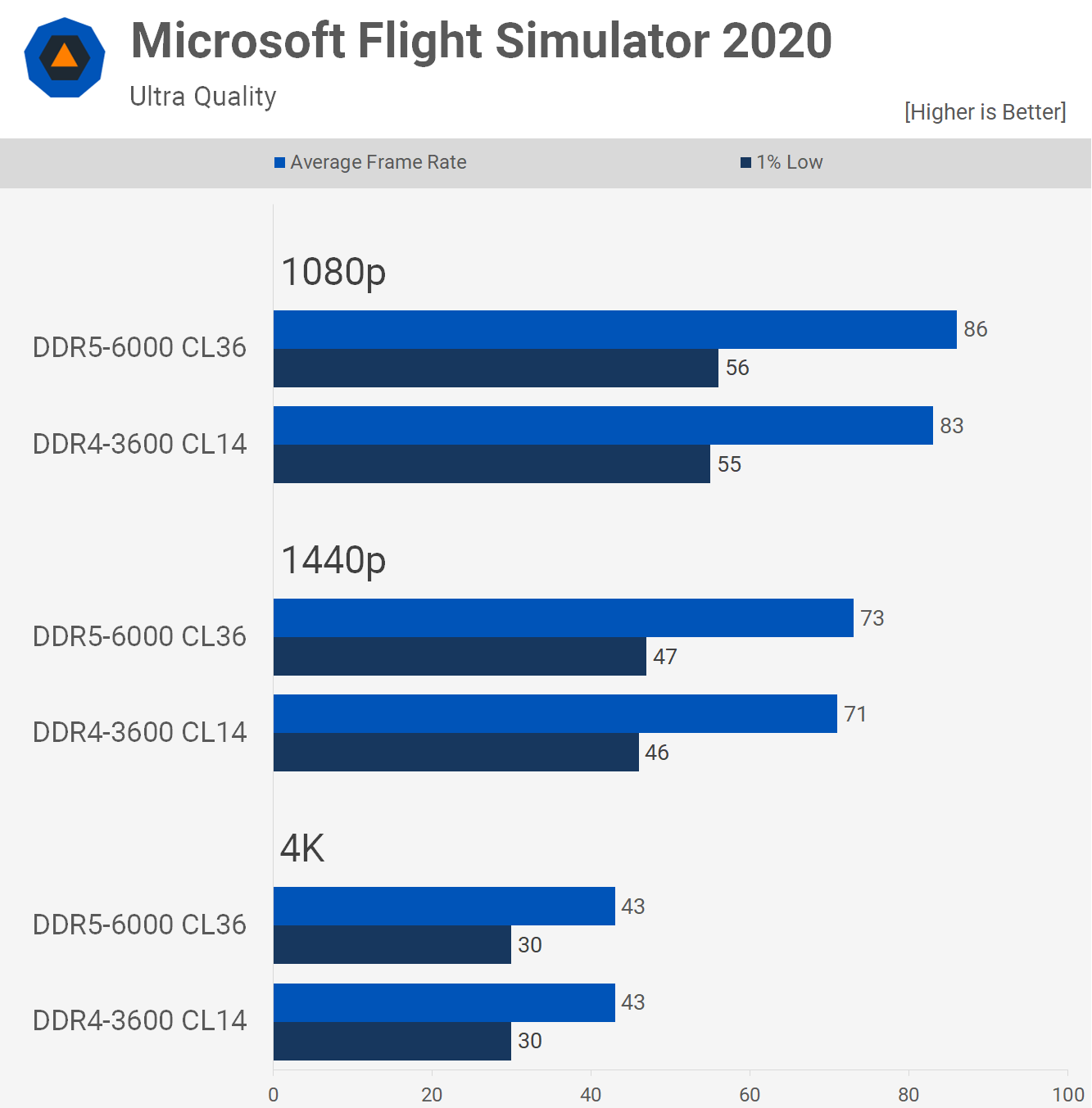
For testing Microsoft Flight Simulator I'one thousand using the latest DirectX 12 version and hither nosotros're simply seeing mild gains in the range of low single-digit percentages, so nothing to get excited about.
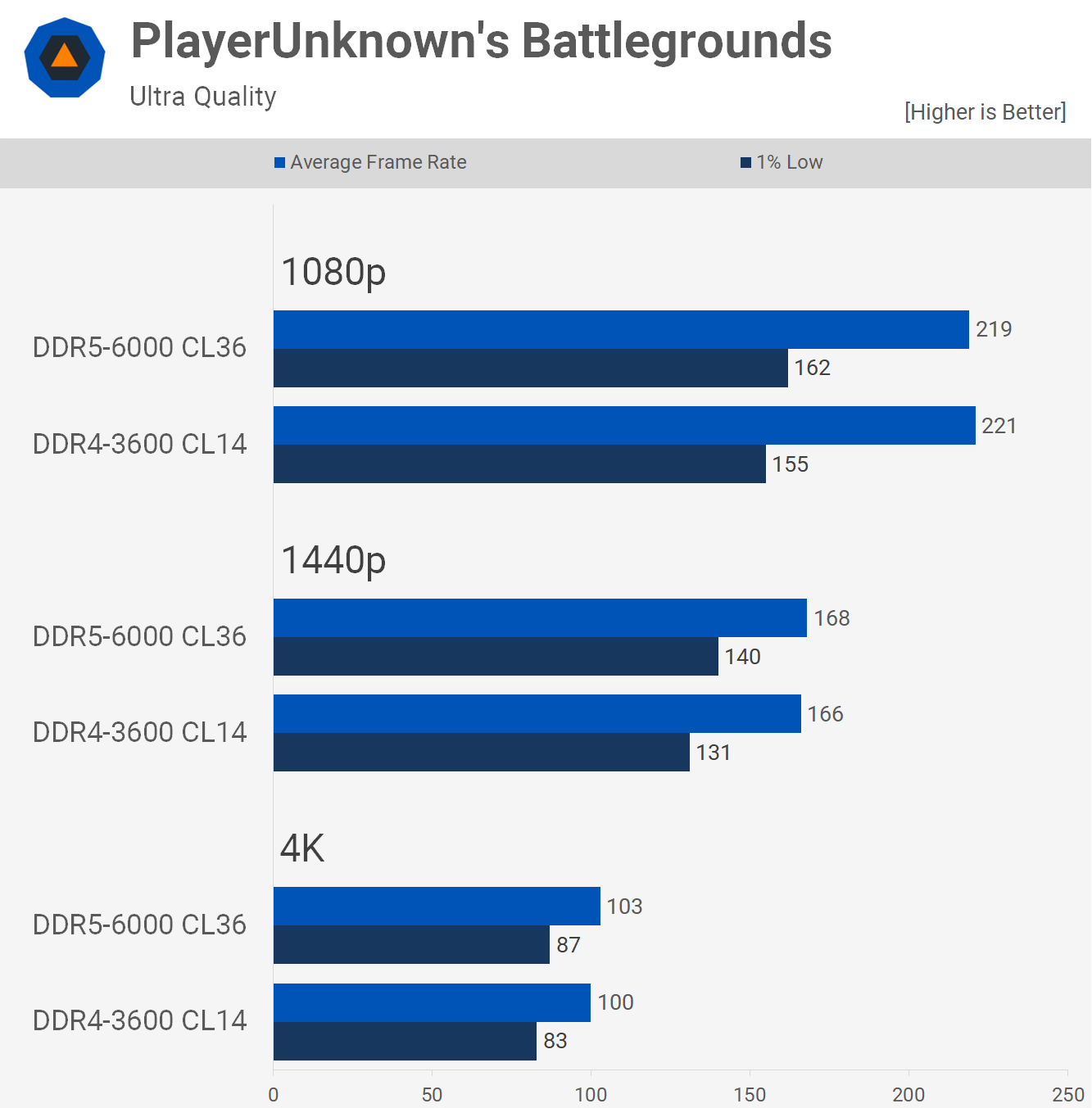
Testing PUGB shows a small improvement to the 1% lows with DDR5, about 5 - 7% so nil to write home about. Meanwhile, the average frame rate remained much the same, so either memory technology volition permit you lot to squeeze the nearly out of an Alder Lake CPU in this game.
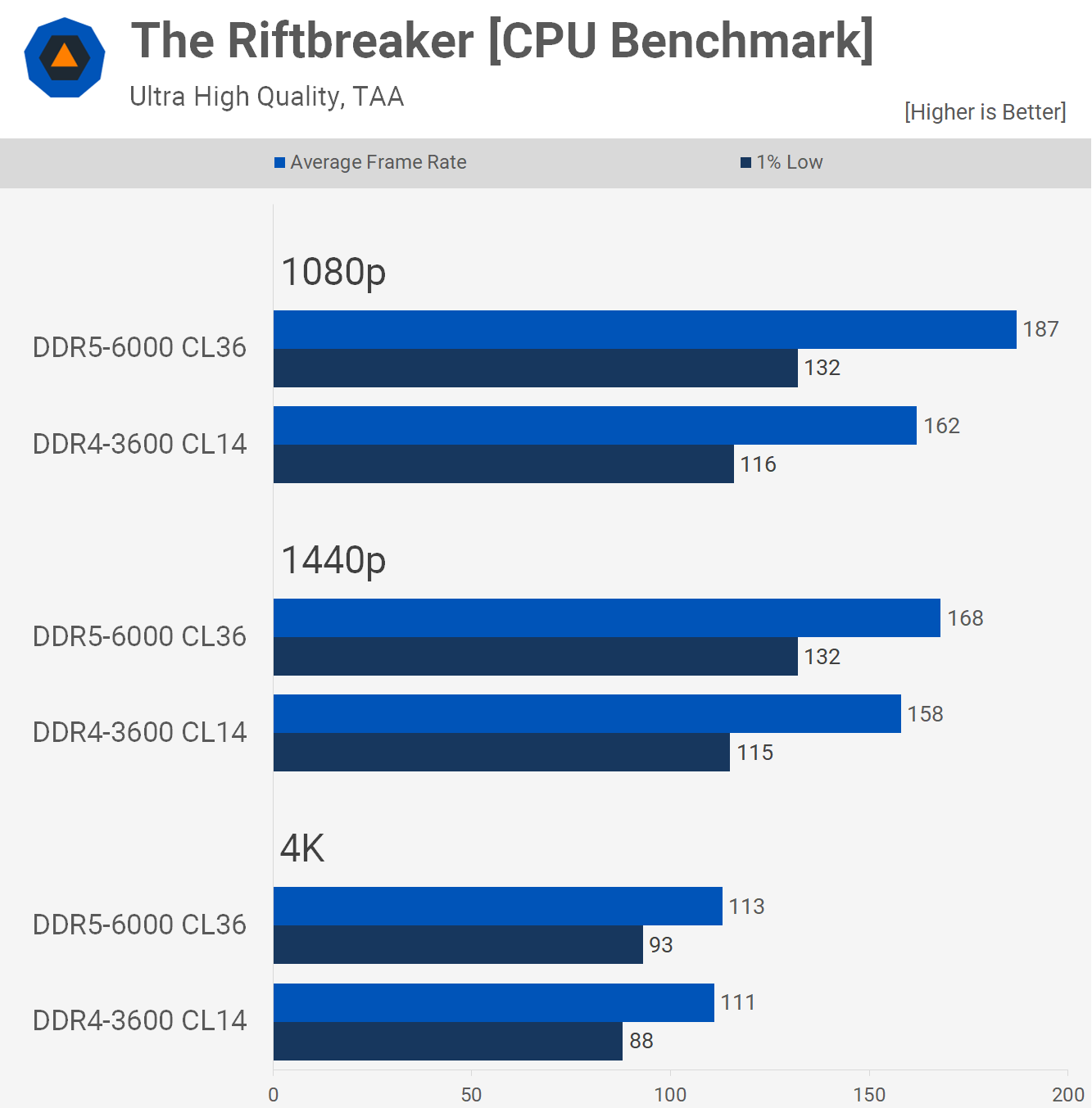
The Riftbreaker is a base-building, survival game with Action-RPG elements, and what makes information technology particularly useful for our testing is that it heavily utilizes the CPU. Riftbreaker utilizes core-heavy processors well and with thousands of units in-game it's a very heavy workload.
Hither we see that the higher bandwidth DDR5 memory has boosted performance at 1080p by 15% and the aforementioned is also seen at 1440p when looking at the 1% lows. Even at 4K we're seeing a small 6% boost to i% lows with the newer memory.
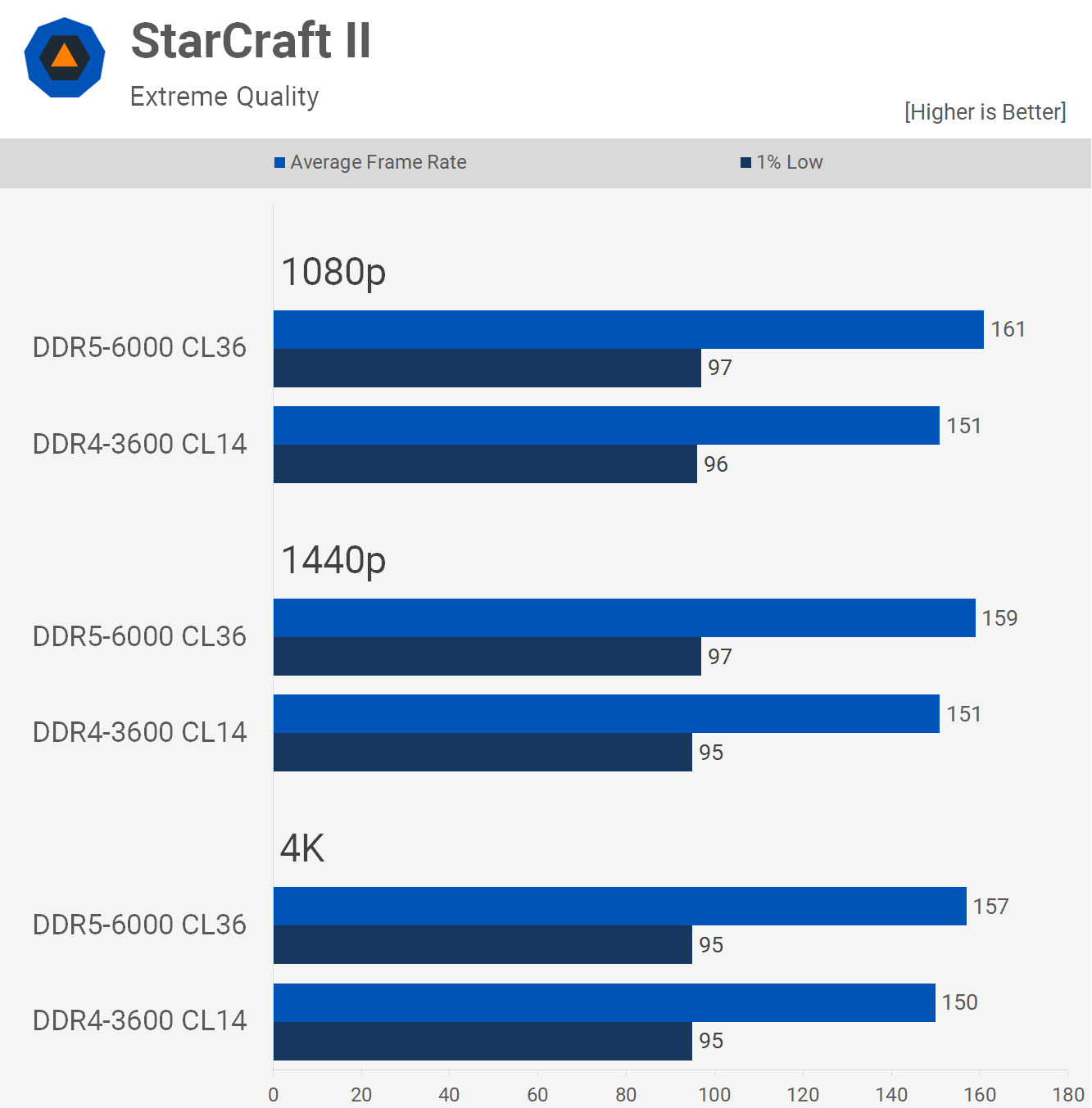
StarCraft II is another CPU intensive game, but for all the wrong reasons. This one-time championship only utilizes a single core heavily, but nosotros see there is some benefit to feeding that core more than bandwidth as performance was boosted past 7%, almost beyond the board.
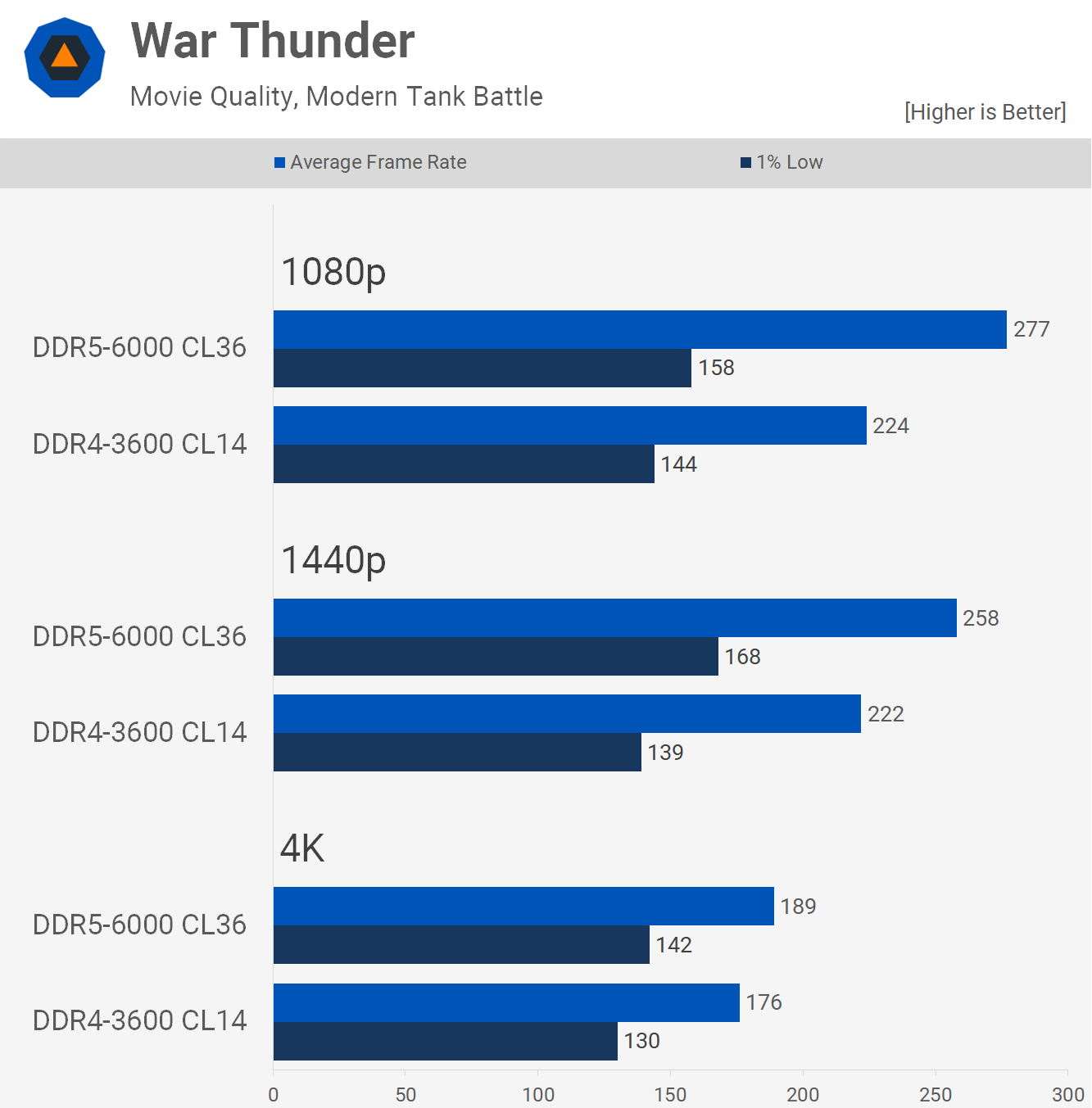
Finally, we accept a await at State of war Thunder and here nosotros're seeing pretty impressive performance gains at 1080p, though how useful a 24% functioning boost is when you're already over 200 fps is hard to argue about. Still, even at 4K nosotros're looking at upwards to a nine% operation heave.
Taking the Average
In total nosotros spent a few weeks testing 41 games and we'll have a look at the side-by-side comparison beyond all those games in a second. Just if we look at an average graph, calculated using the geomean, nosotros run into that on average DDR5 memory offered merely a three% boost at 1080p, 2% at 1440p and then one percent at 4K.
Based on those figures, DDR5 does very picayune to aid the Core i9-12900K across a wide range of today's games.
41 Game Breakdown
Now here'southward a wait at the individual results for all 41 games, focusing on the 1% lows.
As we only saw, DDR5 offers a 3% performance boost overall, merely here we can see that gains were as big as 20% in games such as Far Cry 6 and Brilliant Memory. Other games to show strong gains include Watch Dogs Legion, Assassinator's Creed Valhalla, The Riftbreaker, and Fortnite, to name a few.
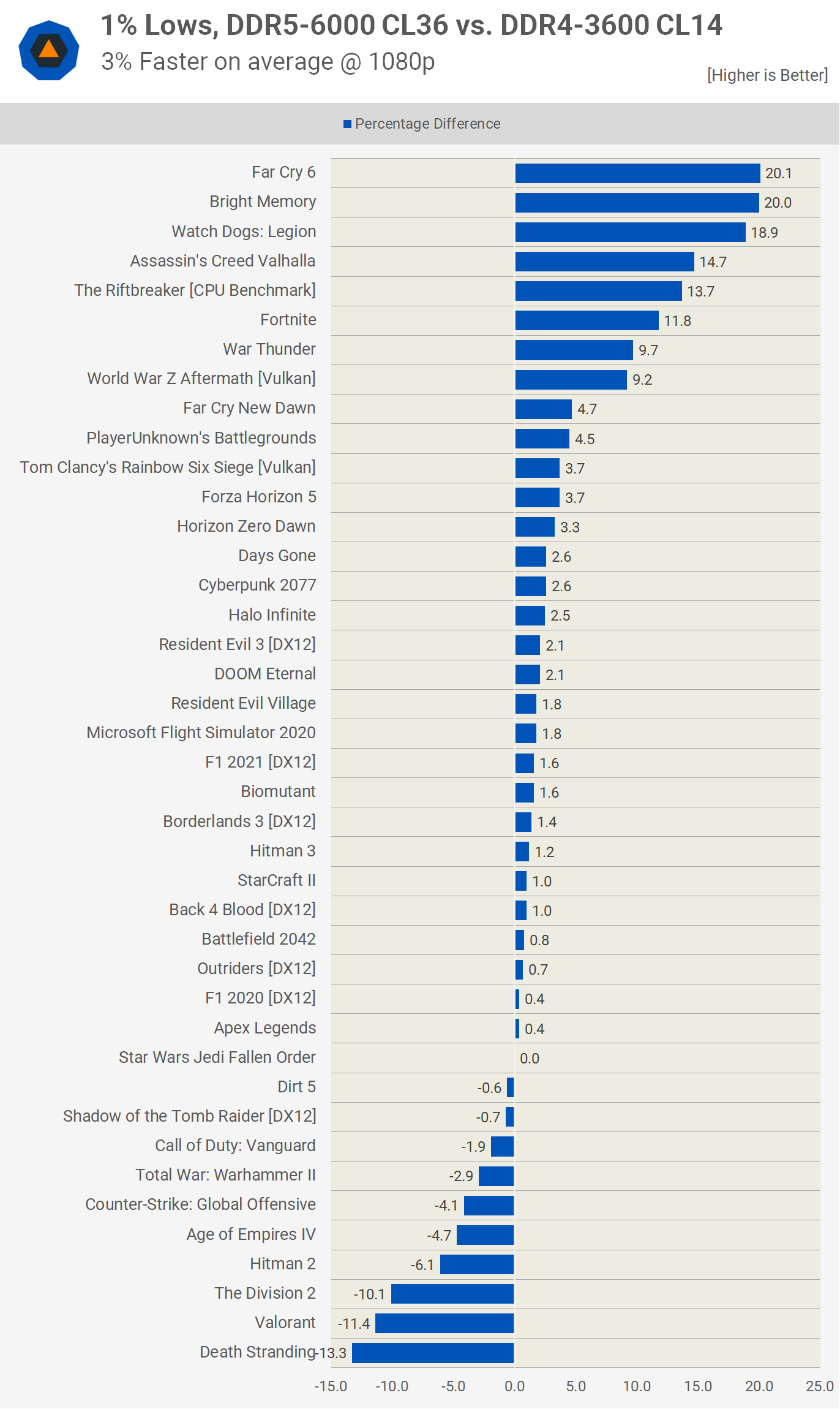
There were also games that ran slower with DDR5, past a five% margin or greater, such as Historic period of Empires, Hitman 2, The Segmentation 2, Valorant and Expiry Stranding.
Moreover, of the 41 games tested, 26 of them saw 4% or less variation in performance, which is basically nothing and gameplay is identical. So for over 60% of the games tested performance was a friction match. It's also worth noting that for 75% of the games tested, DDR5-6000 memory failed to offer over a 5% improvement.
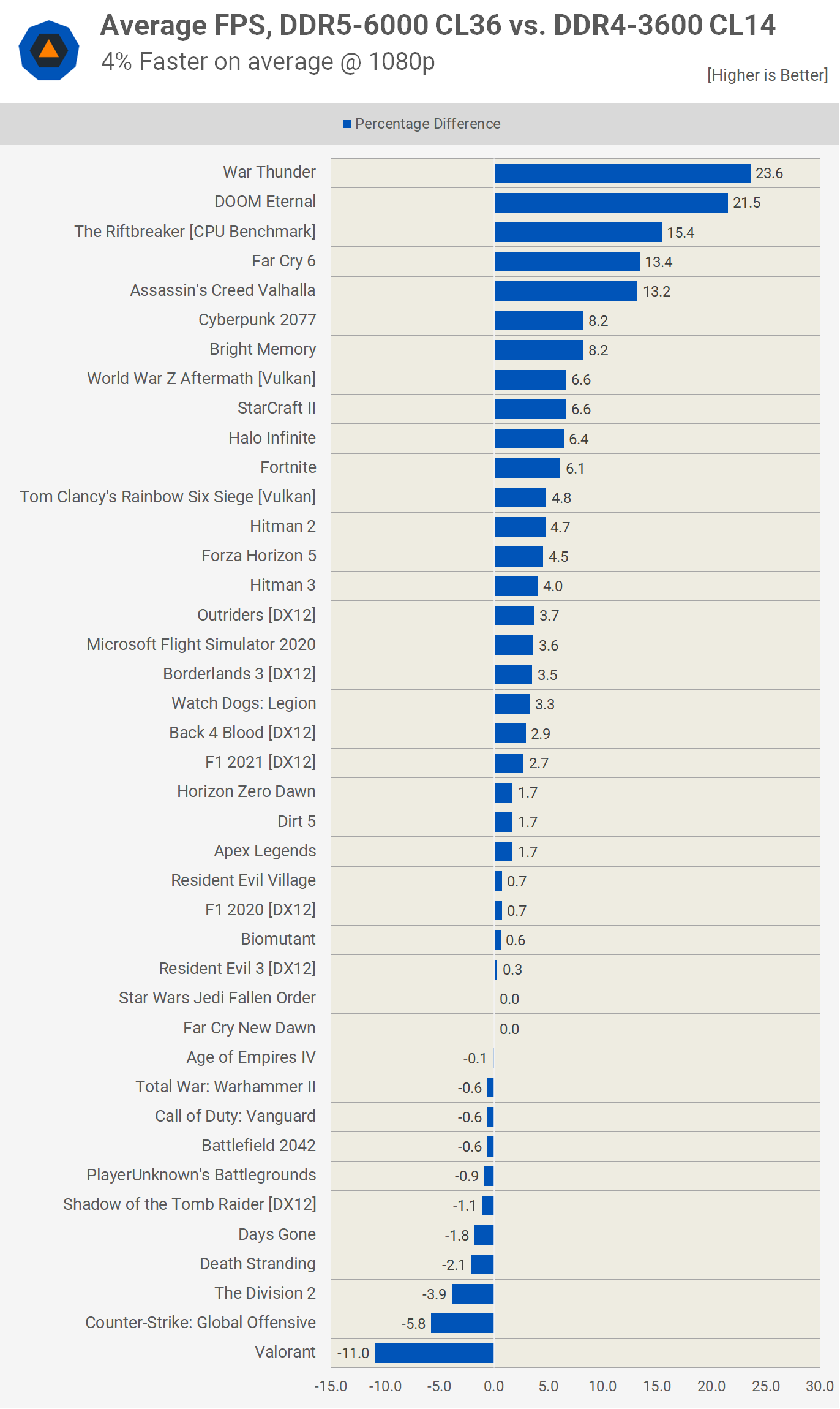
For those of you wanting to see the average fps data, here's a look at that...
The data does move around a chip. For example, War Thunder is now showing the all-time results for DDR5, along with Doom Eternal. Merely overall we're looking at very similar functioning trends.
Bottom Line
Depending on the games you play, DDR5 retentivity can offering little to no operation proceeds, and this volition be true for well-nigh titles. The best performing examples bear witness upward to a twenty% boost which is significant, and here we're comparison premium DDR4-3600 memory to premium DDR5-6000, with the DDR5 kit coming in at a ~seventy% price premium.
Conspicuously DDR5 isn't worth it right now, only we already knew that. Pricing aside, DDR5 has niggling to offer over DDR4 in today'due south games with an Alder Lake processor for the most part. That being the instance, budget conscious shoppers should only consider DDR5 at a ten%, or possibly a 20% price premium at nigh, when going for a flagship part like the Cadre i9-12900K.
The value equation is considerably worse for DDR5 when comparing sweetness spot retention similar DDR4-3600 CL16, for example. The Yard.Skill Ripjaws V Series 32GB can be had for just $135 and that's for the 32GB capacity kit. Meanwhile, the cheapest DDR5 32GB kit listed on Newegg right now is Corsair's Vengeance for $310 and it's out of stock. That's a 130% price premium when comparison with sweet spot DDR4 retentivity, yikes.

It should as well be noted that for the vast majority of games y'all can however easily get abroad with 16GB of RAM, peculiarly if you're a skilful lobster and go along your Bone clean. It's very easy to snap upwards a DDR4-3600 CL16 16GB kit for well nether $100, the Ripjaws V, for instance is just $80.
It should also exist noted that for the vast majority of games you can withal hands go away with 16GB of RAM.
We can besides address the "hereafter-proofing" argument, which came upward a lot on our initial Alder Lake reviews. The bones statement is this: invest in DDR5 now, and so you don't have to change your motherboard later if you want to upgrade to 13th-gen Core (codenamed Raptor Lake).
But wait... Raptor Lake volition back up DDR4 retentiveness, and while it'southward possible DDR5 will be of more benefit in a year, it's still not going to be massive and gamers will nearly e'er stop up GPU limited in games, rather than CPU limited. The large issue with this futurity-proof argument is the aforementioned every bit earlier, they hinge on the investment paying off in the long run with very few short-term advantages.

In the instance of this statement, allow's take a rather expensive mid-range motherboard such as the Gigabyte Aorus Elite AX. It's $270 for the DDR4 version or $290 for the DDR5 version, so already you're paying a seven% premium for the DDR5 motherboard. As seen before, a sensible 32GB DDR4-3600 CL16 kit will price you $135, so that's $270 for the motherboard, $135 for the retentivity, and let's become crazy with the Cadre i9-12900K for $620 = a $1,025 combo.
Now, if we went with the cheapest DDR5 memory nosotros can find at Newegg, the Corsair Vengeance DDR5-4800 CL40 32GB kit for $310, add together the $290 Aorus Elite AX DDR5 with the Core i9-12900K, and you take a package cost of $1,240, roughly a 20% premium overall.
The problem is, I expect DDR5-4800 CL40 memory to be slower than DDR4-3600 CL16, and so what's the point of paying a xx% premium for slower retentivity?

If we recalculate using the memory tested here, the Trident Z RGB, DDR4-3600 CL14 and DDR5-6000 CL36 nosotros find a similar margin using the Cadre i9-12900K and Aorus Aristocracy AX, basically DDR5 ends upwards costing twenty% more.
DDR5 available right now is going to be terrible when compared to DDR5 memory in a year or two...
Yous could argue that a twenty% premium is worth information technology given nosotros're already seeing examples of 20% gains in games. But you're better off saving the coin for a hereafter upgrade considering the DDR5 bachelor correct now is going to be terrible when compared to DDR5 memory in a twelvemonth or 2. We saw the same thing happen with DDR4, and DDR3 before it.
As we explained in our showtime Alder Lake review, you tin brand a reasonable case for DDR5 with the Core i9-12900K, given it's such an expensive CPU. Merely our advice for gamers is to become with the much amend value Cadre i7-12700KF for just $395 -- and at that point the DDR5 package is 25% more expensive -- and so almost thirty% more with the 12600K.

For upkeep-witting gamers looking to jump on Alder Lake with a Cadre i5 or i7, my advice is to snap up an entry-level Z690 motherboard such as the Gigabyte Z690 UD DDR4 for $200 or the MSI Z690-A Pro DDR4 for $220 and pair that with an affordable DDR4 kit such every bit the Ripjaws V for $135.
If Raptor Lake does end up being a big step frontward and worth upgrading to, you'd exist all-time off just buying a new Z790 motherboard with DDR5 retentivity and selling the DDR4 gear 2d hand equally it volition retain its value well, Intel motherboards always do due to heavy product segmentation. At that point you should be getting a better motherboard anyway and much higher quality DDR5 retentivity at a significantly better toll.
Also, chances are 12th-gen Core series owners won't feel the need to upgrade until 14th-gen hits at the absolute earliest, and at that signal yous'd need a new motherboard anyway.

Now that we've compared DDR4 and DDR5 memory across a massive range of games, the adjacent pace is to provide a detailed memory scaling video for Alder Lake and that'due south already in the works. The plan is to compare a wide range of DDR4 and DDR5 memory to discover the sweetness spot for Intel twelfth-gen series, in both games and applications. Stay tuned for that.
Shopping Shortcuts
- G.Skill Trident Z Neo DDR4-3600 CL14 on Amazon
- K.Skill Trident Z5 RGB DDR5-5600 CL36 on Amazon
- Corsair Vengeance RGB Pro DDR4-3200 CL16 on Amazon
- Corsair Vengeance DDR5-4800 on Amazon
- Kingston Fury Renegade DDR4 CL18 on Amazon
- MSI Z690-A Pro WiFi DDR4 on Amazon
- Gigabyte Z690 Aorus Aristocracy AX DDR4 on Amazon
- MSI Z690 Tomahawk WiFi DDR4 on Amazon
- Asus TUF Gaming Z690-Plus WiFi D4 on Amazon
- Intel Core i5-12600K on Amazon
- Intel Core i7-12700K on Amazon
- Intel Cadre i9-12900K on Amazon

Source: https://www.techspot.com/review/2387-ddr4-vs-ddr5/
Posted by: sototheack.blogspot.com
0 Response to "DDR4 vs. DDR5: The Best Memory for PC Gaming"
Post a Comment